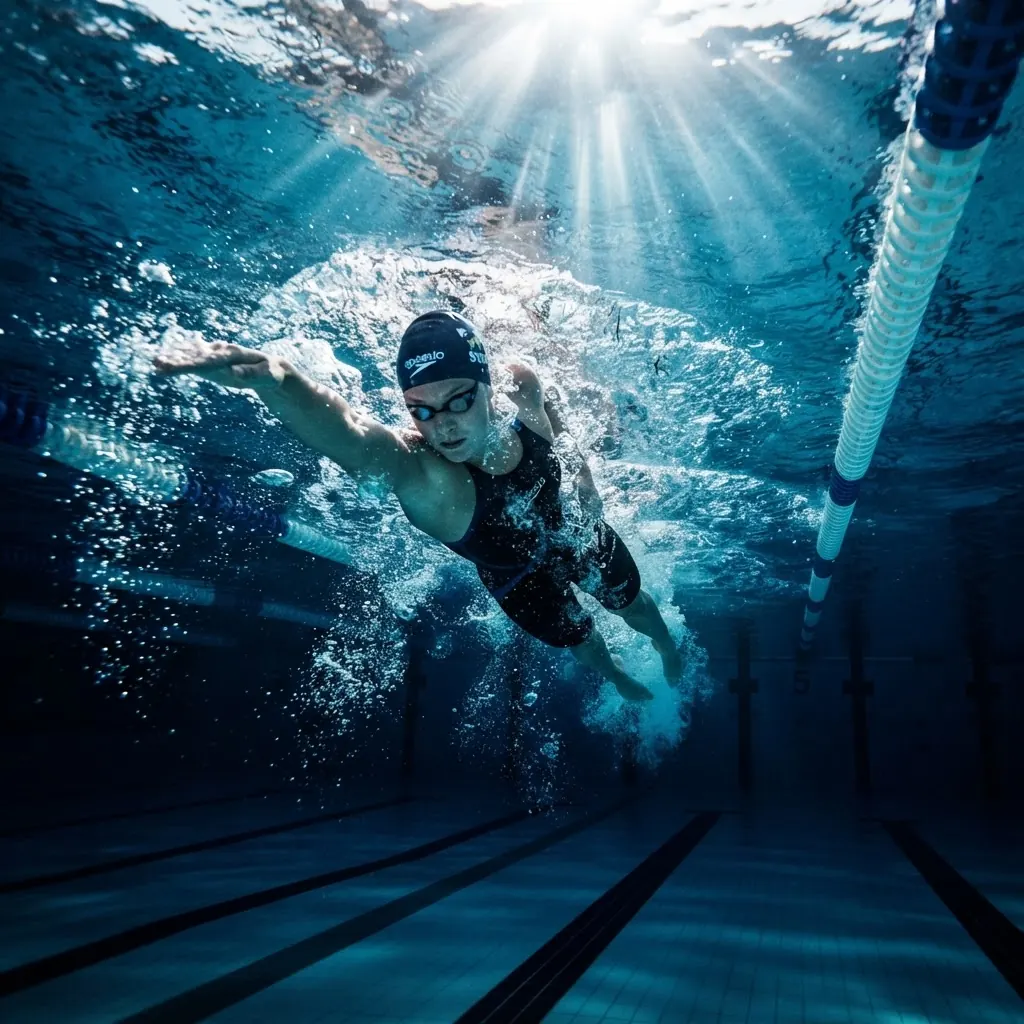
Coming back to swimming after years away, or starting for the first time, is intimidating. You get to the pool, you swim a few lengths, and you are already out of breath. With a clear progression, anyone can swim 1000m without stopping in 8 weeks.
Why you get out of breath (and how to stop)
Swimming is the only sport where you manage your breathing with a partial breath-hold. On a bike, or on a run, you breathe whenever you want. In the pool you have 2 to 3 seconds in each cycle to inhale. Miss it, and you panic, you lift your head, and the whole stroke falls apart.
The main beginner mistake: swimming too fast, and panicking as soon as it burns. You then push harder, swim even faster, and stop after 25m.
The fix feels backwards: swim more slowly. Really. A pace where you could hold a short conversation. If you are gasping, you are going too fast. It is that simple.
The 3 technical mistakes that exhaust beginners
1. Head too high. If your head breaks the surface, your hips drop, and your body creates a huge amount of drag. Keep your eyes on the bottom of the pool, and lift your head only to breathe.
2. Legs that sink. A kick that thrashes in every direction, without pushing you forward, drains your energy. The kick stays compact (heels near the surface, no big knee bend) and loose.
3. No glide off the wall. Each solid push off the wall gives you 3 to 5 free metres. Use them: glide in a tight streamline before the arms start again. You save energy, and you go faster.
How a beginner session is built
A well built session, even a short one, produces more progress than a long session with no plan.
The warm-up (10-15%). Do not dive in all-out. Swim 2 easy lengths to feel the water, settle your breathing, and lengthen out. Your body needs the right line before the effort goes up.
The main set (70-75%). Short repeats, with rest. For a beginner: 6×50m with 15" of rest, rather than one continuous 300m. Same total distance, much less gasping, and better quality.
The swim-down (10-15%). Two lengths on your back, very slowly. It matters as much as the warm-up for letting the muscles settle.
The plan, week by week
Weeks 1-2: find your feel for the water Goal: swim 400m in the session, without stopping inside the short sets. Typical format: 6×50m front crawl, R15". If you are gasping, it is too fast · 4×50m backstroke, R10" · Swim-down
Weeks 3-4: build endurance Goal: link 100m repeats without stopping. Typical format: 4×100m front crawl, D3'30", conversation pace · 4×50m pull buoy, R15" · Swim-down
Weeks 5-6: lengthen the sets Goal: hold 200m without stopping. Typical format: 3×200m front crawl, D5'00", breathe every 3 strokes · 4×50m kick with a kickboard · Swim-down
Weeks 7-8: the 1000m Goal: link 1000m in a single session. Typical format: 2×400m front crawl, R30". You stop to drink, not to gasp · 200m easy backstroke
By the end of week 8, most beginners can swim 1000m without a break. Some get there in week 6.
Technique first: the drills worth doing
You improve 2x faster with 10 minutes of technique in each session than by swimming without a focus.
Swim with fins. Fins cover for the legs and free your attention for the upper body. You feel shoulder rotation and the catch straight away, and your body stays horizontal without a fight. Essential when you are starting out.
Front snorkel. A front snorkel takes the breathing problem away. You swim with your head on the axis the whole time, and you feel the line from head to hips to feet without twisting your neck. Ideal for working the arms, stroke after stroke, with no interruption.
Backstroke with both arms together. Swim on your back and pull with both arms at the same time (like butterfly, on your back). This drill builds a feel for the catch on your back, for a tight trunk, and for even support on both sides. What you fix here transfers straight into your front crawl.
3 front crawl strokes / 3 backstroke strokes. Alternate 3 front crawl strokes and 3 backstroke strokes, continuously, without a stop. Each change forces your body to reset its line, and you learn to vary the catch. It breaks the monotony, and you feel how propulsion differs between the two strokes.
How many sessions a week if you want to improve?
2 sessions a week. That is the minimum if you want to improve. Below that, the body "forgets" the feel between sessions, and you start from zero each time.
3 sessions a week. The sweet spot for a beginner. You will see clear progress from one week to the next.
4 sessions a week, or more. Watch the recovery. The body needs time to absorb new sensations. Swimming a lot while repeating the same mistakes can lock bad habits in.
Consistency beats volume. Two well built sessions of 45 minutes are worth far more than one long, chaotic session a week.
Switch to structured training
Create your personalized swim plan in 2 minutes, matched to your level and goal.
Create my plan