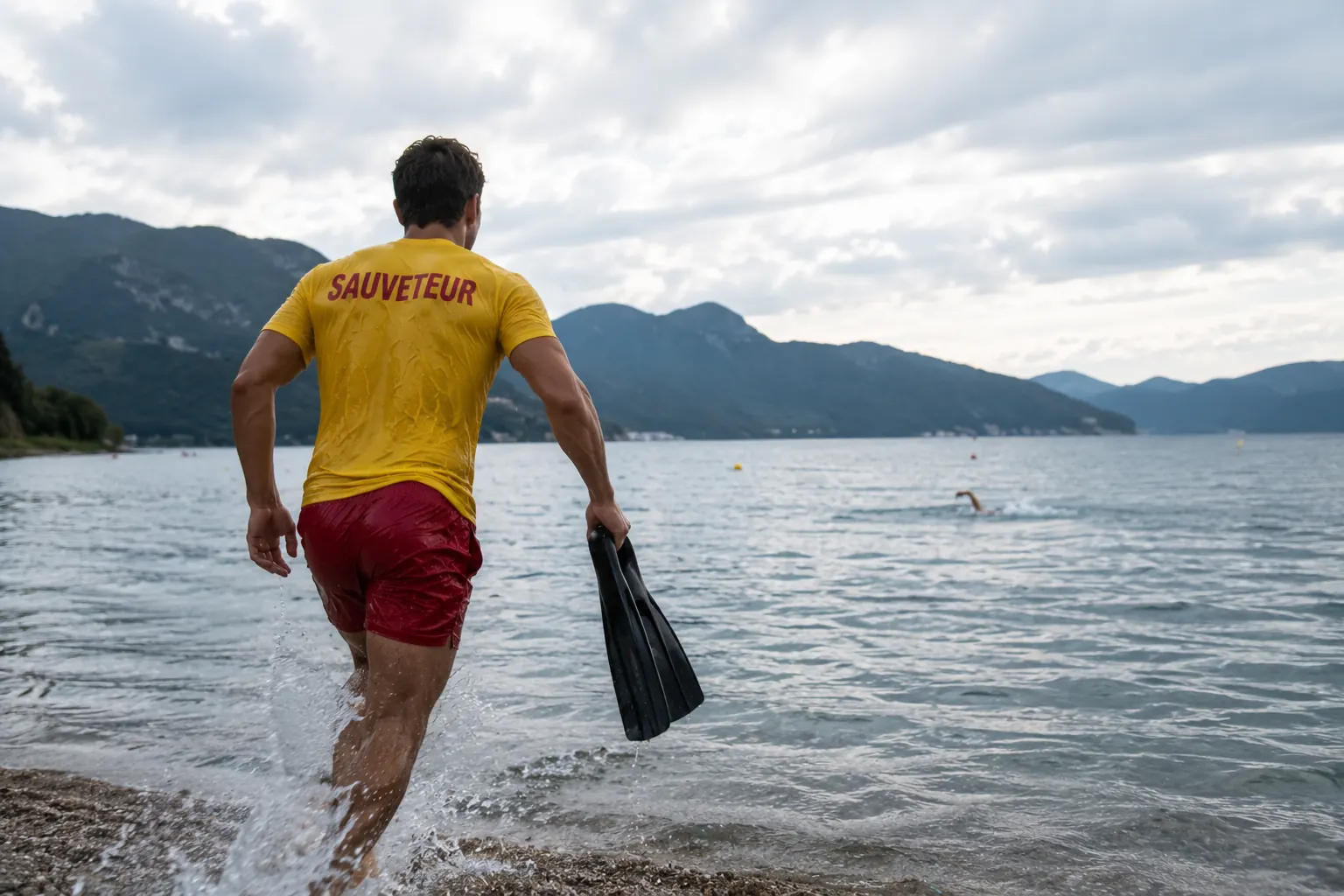
The BNSSA (Brevet National de Sécurité et de Sauvetage Aquatique) is the reference qualification for supervising swimmers. Its swim tests are demanding: apnea, towing, speed. They need specific preparation. Here is how to approach each test.
The BNSSA swim tests
The BNSSA has three aquatic tests, and each one is eliminatory:
Test 1, 100m rescue (time limit: 2'40"). The course: 25m freestyle, then a dive (15m of apnea along the bottom), then a wall turn, then 15m of apnea on the way back, then 25m towing the manikin on its back. You do it with no equipment, in the regulation kit. On a retake, the time limit goes to 3'00".
Test 2, 250m fins/mask/snorkel (time limit: 4'20"). A 250m equipped swim in the pool, done without a stop. The goal is to show endurance and control of the equipment inside the time allowed.
Test 3, help for a person in difficulty (no time limit). The jury scores the quality of the intervention, the lifeguard's safety, and how the person is looked after. There is no set clock: the whole performance is what is marked.
These three tests are eliminatory, and they take place on the same day.
Dynamic apnea: the key to the 100m rescue
This is often the test that worries people most. Dynamic apnea is trained like any other swimming skill.
How do you work it?
Start with short underwater swims: dive to the bottom and cover 10m, then 12m, then 15m, step by step. The BNSSA target is 15m fully submerged, with no push off the bottom and no feet on the floor.
Mistakes to avoid: - Hyperventilating before the apnea (dangerous, and it works against you) - Looking upward (it breaks your streamlined line) - Putting your feet or your hands on the bottom
The right technique: A normal breath, not an excessive one. Enter the water in a tight torpedo, arms along the body or in streamline. Breathe out on the way up, never on the way down.
Do 3 to 4 apnea sets in each BNSSA session, with 2 minutes of recovery between them. Quality beats quantity.
Towing: technique and endurance
Towing an 8kg manikin for 25m, after 50m of swimming, is exhausting. Technique makes up for a large part of the effort.
The back-float position. You hold the manikin on its back, face clear of the water, your arms under its armpits and your hands crossed on its chest. You swim on your back with a strong kick.
Your arms. They propel with a compact side sweep, and they stay in the water. The movement is short and steady.
How to last: Start by training with no manikin, then with a partner (lighter), then with the regulation manikin. That progression is essential.
In a serious programme, plan 3 to 6 lengths of towing per session late in the build-up.
The 250m with fins, mask, and snorkel: endurance and control
This test is often underestimated. Swimming 250m with the gear on, and without stopping, takes specific endurance and real control of the equipment.
Get the gear right: - Short swim fins, or rescue/dive fins from the brand Mares - A mask that fits, with no leak. Check the seal on dry land before you start - A fixed snorkel, with no purge valve (BNSSA regulation)
The main mistake: Chasing speed. The test is timed (4'20" maximum), but the priority is still to finish without a stop. Hold a steady pace from the gun. A start that is too fast ends in a cramp, or in panic, halfway down the pool.
The training: Add sets of 4×50m with the gear, then 2×100m, then 1×200m, step by step. Fins plus snorkel change your balance in the water, and that needs an adaptation.
A sample 8-week BNSSA plan
Here is how to structure your last 8 weeks before the tests:
Weeks 1-2: base 2 sessions a week. Freestyle endurance, plus the first short apneas (10m). Get used to the gear (fins and mask).
Weeks 3-4: build 3 sessions a week. Apneas at 12m. Towing with a partner. 2×100m with the gear.
Weeks 5-6: specific 3 sessions a week. A full simulation of the 100m rescue (not timed). Apneas at 15m. Manikin tow, 2×25m.
Weeks 7-8: taper Timed simulations. Lower volume. Trust in what you have done.
In ForSwim, the BNSSA plan builds these phases in automatically, with the sessions written out (apnea, towing, course simulation) for your level and your weekly frequency.
The mistakes BNSSA candidates make most often
Turning up with no open-water swimming behind you. The BNSSA takes place in a pool, but a few things can still surprise you: poorer visibility, colder water. Training in varied conditions helps.
Underestimating stacked fatigue. The tests follow one another on the same day. If you can chain the 100m rescue, the 250m with fins, and the physical tests in one session, you are ready.
Neglecting technique. A lot of candidates prepare the BNSSA with volume only. Thirty minutes of technical work a week (apnea, towing, the back-float position) is worth more than 2 hours of swimming that does not match the test.
Panicking in the apnea. Stress uses oxygen. Candidates who miss the apnea often miss it from stress, not from a lack of physical ability. Rehearse the conditions in training so the pressure feels familiar.
Switch to structured training
Create your personalized swim plan in 2 minutes, matched to your level and goal.
Create my plan