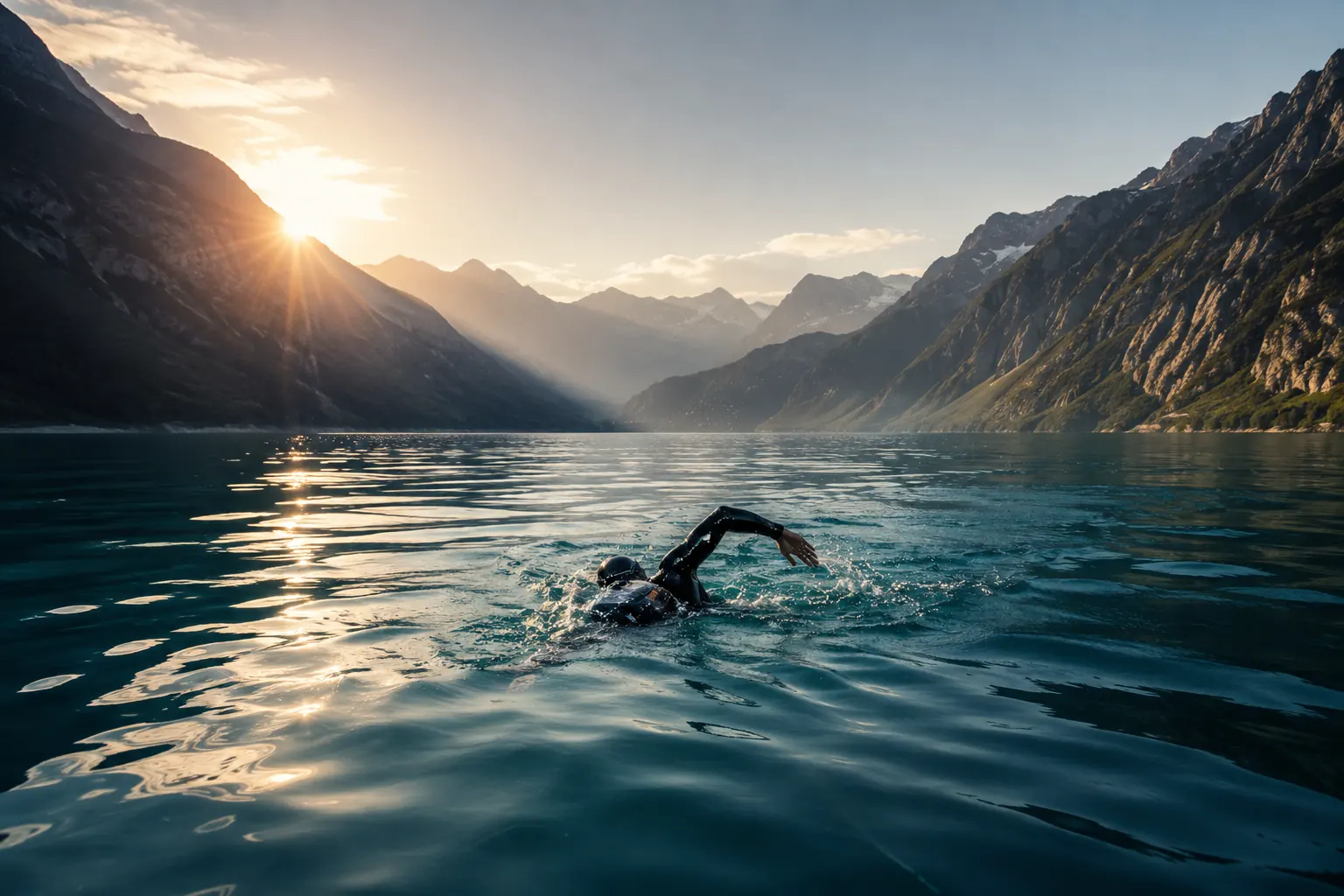
You swim well in the pool. You know your paces. And still, the first time you swim in a lake or in the sea, you are in the red within three minutes: line lost, rhythm broken, a light panic on the breath.
It is not that you are "bad". The pool lies to you a little. Black lines, walls, calm water, a stable temperature: everything is marked out. In open water you have to rebuild those markers yourself.
The good news: most of the useful skills are trained beforehand, in the pool. Here are the 7 priorities.
1. Sighting (lift your head to aim)
In open water there is no line on the bottom. You lift your eyes regularly, to aim at a buoy, a shore, a tree.
In the pool: every 6 to 8 strokes, lift the head just enough to look forward, then go back to your usual breath. Keep the hips high. The classic trap is lifting too high, so the legs drop.
The goal is a quick glance, not a sightseeing pause. The more economical the move, the less speed you lose.
2. Swim straight with no line
Even with sighting, a lot of swimmers zigzag. A common cause: a stronger pull on one side, or an uneven roll.
In the pool: close your eyes for 8 to 12 metres (only if the lane is clear and it is safe), then open them and see where you are. Repeat. You find your natural "bias" quickly.
Then correct it on purpose: a more even pull, a more even roll, and eyes that come back to the centre after each breath.
3. Breathe to both sides (bilateral)
Wind, waves, the sun, a swimmer on your left: sometimes you can only breathe to one side. If you have only one option, you are fragile.
In the pool: alternate 3-3 (a breath every 3 strokes) on sets of 50 or 100 m. You do not have to do it all the time, but you need to be able to hold it without panic, and without breaking your rhythm.
4. Start hard, then find your pace
In a triathlon, or in a mass start, the first minutes are chaotic. A lot of people leave too fast, then blow up.
In the pool: work negative splits, or a "fast start + cruise". Example: 4×100 m, 25 m a notch above, then 75 m at your target pace. You learn to absorb the rush without burning the whole repeat.
In open water, as in a structured plan, even pace beats a suicidal sprint.
5. Tolerate the discomfort of the first minutes
Cold water catches your breath. The wetsuit compresses you. The stress rises. It is not always a heart-rate problem. It is often an adaptation problem.
In the pool: sometimes open the session with 100-200 m a little harder, after a very short warm-up, to rehearse that "first shock". Also practise a longer exhale in the water: a full exhale calms you more than a forced inhale.
If you have a wetsuit, do at least 2-3 sessions in it before a race. The shoulders, and how high you float, really do change.
6. Keep a simple stroke when you are tired
In open water, the "perfect" pool stroke falls apart fast: you are sighting, you get bumped, you tense up. What you need is a robust stroke: a solid catch, a stable rhythm, a useful kick that is not over-revving.
In the pool: favour short drills, then swimming that applies them. Do not turn the whole session into drills. Work sets where you hold the same stroke count per length as you get tired. Steadiness beats a gesture made for a photo.
7. Know what you are aiming at (pace / effort)
With no wall clock, a lot of people swim "by feel", and feel lies when the adrenaline is up.
In the pool: learn your zones. What is a truly easy Z2 for you? What is a threshold pace you can hold? If you know your 100 m and your target paces, you can find those sensations outside: a controlled breath, a familiar pressure of water on the hands, a stable stroke rate.
On the day, you are not chasing an all-time best off the first buoy. You are chasing your race rhythm.
A 2-week mini-plan
Session 1, sighting + bilateral Warm-up 300 m · 8×50 m, sighting every 6-8 strokes · 6×100 m, breathing 3-3 · Swim-down 200 m
Session 2, swimming straight + a controlled start Warm-up 300 m · 6×50 m with eyes closed (only if it is safe) · 6×100 m (25 m fast / 75 m cruise) · Swim-down 200 m
Session 3, easy volume + wetsuit (if you have one) A long Z1/Z2 session, clean technique, no grey zone. The goal is to reach open water fresh in the head, not cooked.
Repeat the cycle, then do a real short open-water swim (20-30 min) to stick the pieces together.
The day of your first open-water swim
Pick a simple spot, with little current if you can. Go with someone. Choose a wide landmark, not a tiny detail. Accept that the first time will be a bit chaotic: the goal is not a performance, it is learning the place.
Only after that do you stack distance and precision.
Open water is not something you "guess". You prepare it, and a good part of that preparation happens between two walls, session after session.
Switch to structured training
Create your personalized swim plan in 2 minutes, matched to your level and goal.
Create my plan