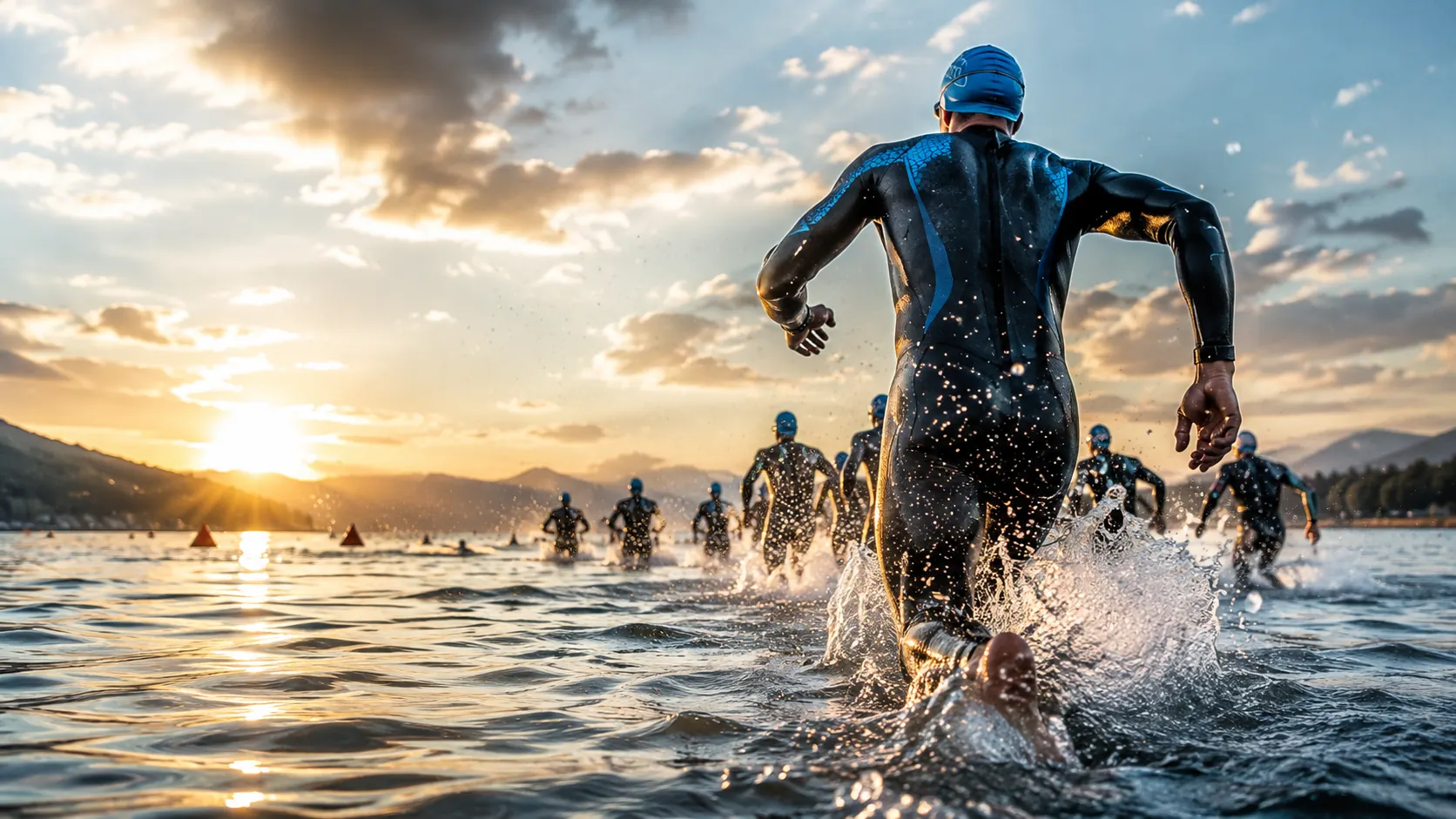
Swimming is often the most stressful leg of a triathlon, especially for beginners. With a structured preparation, it is also the leg where you can pick up the most time without burning yourself out. Here is how to build an effective programme.
Why most triathletes train swimming the wrong way
Most triathletes make the same mistake: they swim "comfortably", neither too fast nor too slow, and they never really work the intensity zones. The result is slow progress, monotonous sessions, and a swim leg you endure instead of control.
An effective programme rests on 3 distinct session types: endurance, threshold, and technique. Each one has a precise role in your progress. Mixing them, or skipping them, leaves performance on the table.
The 3 session types you need
Endurance (Z1/Z2). This is the base. These long sessions at conversation pace build your aerobic capacity. For an Olympic-distance triathlon, aim for 2 to 3 endurance sessions a week in the base phase. A typical format: 8×200m at a steady pace, with 20" of rest.
Threshold (Z3/Z4). This is where you actually improve. Threshold work, also called CSS (Critical Swim Speed), lets you hold a fast pace over the race distance. A typical format: 6×200m at your CSS pace, on a send-off.
Technique. Often neglected, technique is still the best legal boost in swimming. A technical swimmer with less power will always beat a strong but inefficient swimmer over 1500m. Ten minutes of drills per session is enough to improve within a few weeks.
A typical week (3 sessions)
Here is how to split your 3 swim sessions for triathlon:
Monday, base endurance Warm-up 300m · 8×200m Z2, steady pace · 4×50m pull buoy · Swim-down 200m
Wednesday, threshold / CSS Warm-up 300m + 4×25m accelerations · 6×150m at CSS pace, aim for your best even times · 4×50m kick · Swim-down 200m
Friday, technique + negative splits Warm-up 200m freestyle + 200m drills · 6×100m catch-up / DPS · 6×150m freestyle, first half held back, second half faster · Swim-down 200m
This split creates variety, avoids monotony, and covers the 3 energy systems.
How to calculate your CSS (Critical Swim Speed)
CSS is the pace you can hold over 1500m. To calculate it precisely, do a simple test:
1. Swim 400m all-out and write down your time (example: 6'40") 2. Recover for 10 minutes 3. Swim 200m all-out and write down your time (example: 3'00")
CSS = (400m time - 200m time) / 200 = (400 - 180) / 200 = 1.1 s/m = 1'50"/100m
With ForSwim, you enter your best 100m freestyle and the app calculates your training zones automatically. Each session shows you the exact pace to aim for.
The phases of a full triathlon plan
A triathlon plan of 12 to 20 weeks is built in 4 phases:
Base phase (weeks 1-6). Aerobic building. High volume, moderate intensity. This is when you work on technique and gradually increase the distances.
Build phase (weeks 7-12). Threshold work comes in. CSS sessions take a bigger place. Volume stays high, but intensity rises.
Peak phase (weeks 13-16). Sessions specific to the race distance. Speed work, and practice for getting out of the water after a hard effort.
Taper (last 2-3 weeks). Volume drops by 40%. Keep a few accelerations in each session so the muscles stay responsive. The training is done. The body just needs to rebuild.
Open water swimming: what changes
The pool and open water are two different worlds. Here is what you need to prepare for:
Sighting (lifting the head). In the pool, the black lines guide you. In open water, you lift your head every 6-8 strokes to find your line. Add this drill in the pool: every 2 lengths, look up before you breathe.
The mass start. The first few hundred metres of a triathlon are chaotic. Practise leaving hard for 100m, to simulate the jolt of the start, then settle back to your cruise pace.
The wetsuit. It makes you float higher, and you go faster. It also restricts shoulder rotation. Train in it before race day.
The cold. Cold water affects your breathing in the first minutes. Get used to it by swimming the first lengths hard, before you find your rhythm.
Switch to structured training
Create your personalized swim plan in 2 minutes, matched to your level and goal.
Create my plan