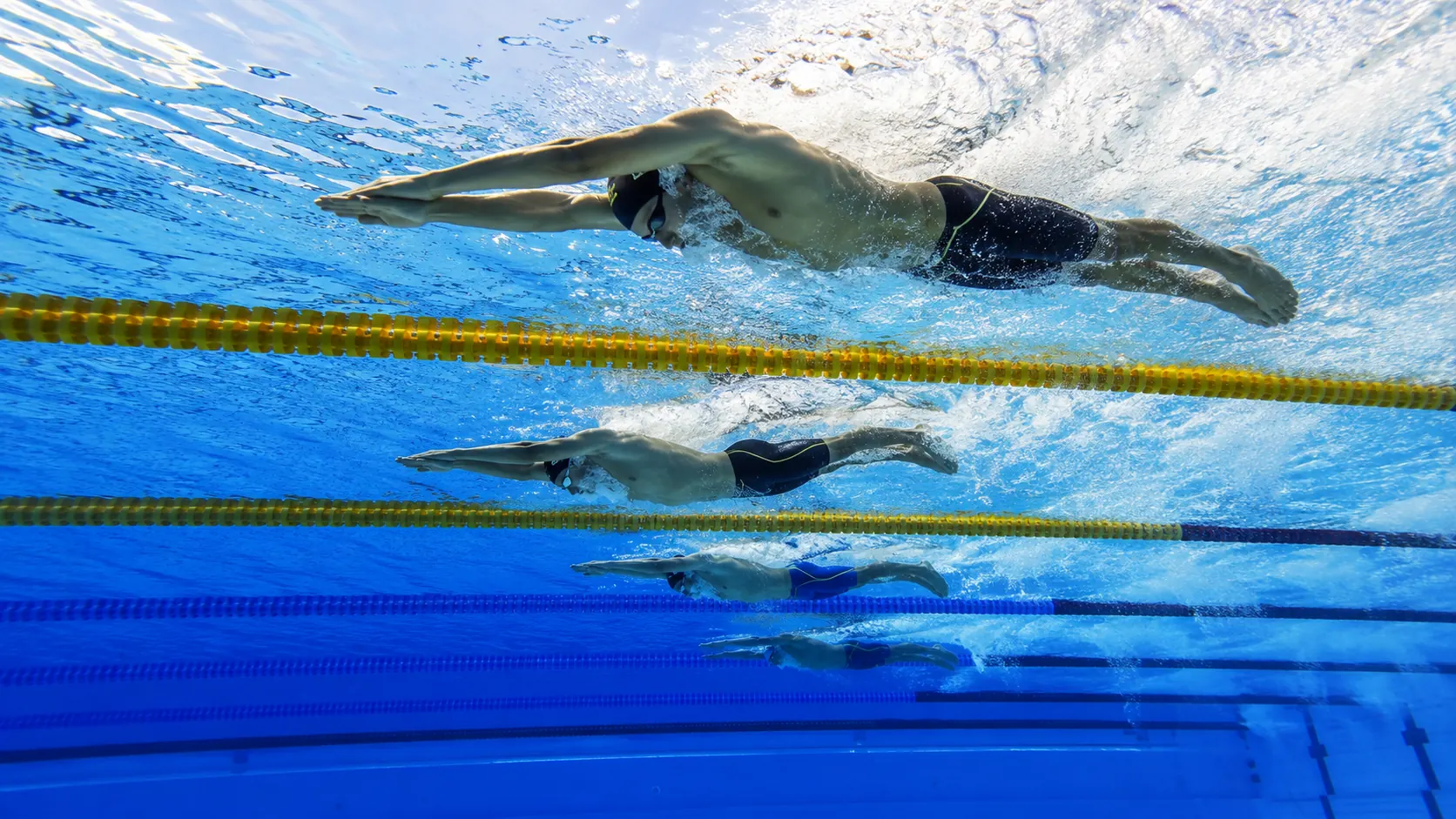
You finish 100 m of front crawl, stop at the wall, and feel like you've just sprinted. Your cardio probably isn't to blame: it's your breathing that's leaving you breathless. The real question isn't "how many strokes between breaths", but "which frequency suits your goal, level, and body type". Here are the three criteria, the mistakes to fix first, and four exercises for your next session.
Why We Breathe to the Side in Front Crawl (and What It Changes)
In front crawl, your face is in the water. You can't breathe whenever you want: you only have a very short window with each arm stroke. Everything else follows from this.
When you turn your head, you don't lift it. Let it roll with your body, one goggle in the water, one ear close to your shoulder. Your body creates a pocket of air in front of your face, and your mouth breathes in without lifting your head. Effortless Swimming sums up the cue: one goggle in the water, one goggle out.
Consequence: exhalation becomes an active movement. Don't hold your breath waiting for the next inhale, blow it out underwater so you arrive empty when it's time to breathe in. That's what turns a suffocating swim into one you can sustain.
Second consequence: the number of strokes isn't a physiological rule, it's a technical choice. It changes depending on the set and your goal.
2, 3, 4, 5 Strokes: Who Really Needs Which?
One "stroke" means one arm movement. So 3-stroke breathing means inhaling every 3 arm movements, alternating right and left. Keep this definition in mind when reading your session.
2-stroke. Inhale every 2 arm movements, always on the same side. This gives you the most air and is the easiest to maintain: beginners, tough sets, open water, triathlon. MySwimPro notes that most swimmers breathe every 2, 3, or 4 strokes, and that 5 or more is about breath control.
3-stroke. Inhale every 3 arm movements, so a different side each time: this is bilateral breathing. It balances your body roll and shows up your weaker side. It costs a bit of air, so you work on it in warm-up and drills.
4-stroke. Inhale every 4 arm movements, always on the same side: two arm cycles between breaths. Light breath control, useful when your technique holds up without much air. Avoid if you get out of breath on 3-stroke.
5-stroke. One step further, alternating sides. This is for experienced swimmers, over short and controlled distances. Not for everyday swimming, and not a goal in itself.
A common myth at the poolside: breathing every 2 strokes is a sign of weakness. That's false. The fastest swimmers often breathe every 2 strokes in races, because available oxygen makes the difference in the last 50 m. 3-stroke is a tool for technique and symmetry, not a badge to earn.
Your frequency by profile:
Beginner who gets out of breath: 2-stroke. On your most comfortable side. 3-stroke only for 25 m drills, when you're fresh.
Regular swimmer: 3-stroke in warm-up and technique, 2-stroke on hard sets. Bilateral is still your symmetry tool.
Triathlete: 2-stroke by default, 3-stroke in the pool. Air in races, weaker side in training.
Open water: 2-stroke, switching sides depending on waves and sun. If you only breathe on one side, a wave can block you.
Three questions to decide. Out of breath? 2-stroke. Asymmetrical body roll? 3-stroke in drills. Can you swim without needing to breathe? 4 or 5-stroke, on short sets.
Body type matters too: a stiff neck, less mobile shoulder, or broad chest need more roll. If one side is much more comfortable, that's your dominant side, not a mistake.
The 3 Mistakes That Leave You Breathless (and Why It's Not Your Cardio)
1. You hold your breath instead of exhaling. This is the number one mistake, even among very fit athletes. You inhale, put your head back in the water, and hold it. When it's time to breathe, your lungs are still half full: you only get a half-breath.
The urge to breathe is triggered by CO2 build-up, not lack of oxygen. U.S. Masters Swimming points this out and notes that even experienced triathletes can only manage a few lengths simply because they're holding their breath. Breathlessness almost always comes from not exhaling underwater, not from the amount of air you inhale.
The fix: as soon as your face goes in the water, let out a stream of bubbles through your nose, then blow out more firmly before you turn your head. Arrive empty, inhale in one go. A simple check: over 25 m, you should be able to count your bubbles without forcing it. If you finish the length holding your breath, you haven't exhaled, you've just held your air. Through the nose or mouth? Both work. The nose helps with a steady, continuous trickle, the mouth gets rid of air faster when you need to. The only real no-no is not exhaling at all.
2. You lift your head instead of turning it. You look forward, your forehead comes out, your hips drop: your body becomes an anchor. MySwimPro says it clearly, looking forward before turning makes your hips sink. Fix it by keeping your gaze down and turning with your body roll, one goggle in the water.
3. You breathe too late or for too long. If you turn your head when your arm is already out of the water, you've lost your support and your body sinks. Breathe early in the cycle, as your opposite arm is pulling, and get your head back before your lead arm enters the water.
A warning: never hyperventilate before swimming and don't try to hold your breath for long underwater. U.S. Masters Swimming explains that hyperventilating suppresses the CO2 warning signal and can cause you to black out without warning.
4 Progressive Drills, Including Bilateral Breathing
You don't need to work on everything in one day. Take the first two if you're still getting out of breath, the next two if you can already swim lengths comfortably.
1. Bubbles at the wall (5 minutes). Standing in the shallow end, inhale, put your head underwater, exhale until empty. Goal: a continuous exhale, longer than your inhale.
2. Single-arm crawl, breathing to the side (4 × 25 m). One arm outstretched in front, breathe with every pull. Learn to turn your head with your body roll, not by lifting. Cue: one goggle in the water.
3. Bilateral breathing every 3 strokes (6 × 25 m). Swim, breathing every 3 arm movements. If you swallow water, slow down: it's a rhythm problem, not a capacity one. Both sides should feel similar.
4. Bilateral then 5-stroke (8 × 25 m). 15 m on 3-stroke, 10 m on 5-stroke, 20 seconds rest. If your technique falls apart, go back to 3-stroke: this isn't an apnea test.
One cue at a time, otherwise you won't fix anything.
How to know it's working. You can do 8 × 50 m on 3-stroke with the same quality on the last set as the first. If the second half gets worse, it's not lack of air, it's lack of exhalation.
How to Fit This Into a Session (Concrete Example)
A 1,300 m session that puts it all together, in a 25 or 50 m pool. You can repeat it once a week.
Warm-up, 400 m. 200 m easy crawl on 2-stroke, then 4 × 50 m with 25 m drill and 25 m swim on 3-stroke, 15 seconds rest. If you're starting from scratch, the 8-week plan to swim without stopping takes you through this progression from the beginning.
Technique block, 300 m. 6 × 50 m on 3-stroke, 20 seconds rest. One cue: turn your head with your body roll. Don't worry about speed.
Main set, 8 × 50 m. 25 m on 3-stroke, 25 m on 2-stroke, 20 seconds rest. Take in more air on the second half, when you get tired.
Cool down, 200 m. Backstroke or very slow crawl. This is the cool-down for your sessions, and the swimming glossary covers all the terms you'll see in a plan.
Two rules. Only one breathing cue per set, don't change frequency mid-set. Only move to 4 or 5-stroke when you can do 8 × 50 m on 3-stroke without getting out of breath. Until then, the problem isn't frequency, it's exhalation.
Short version, 30 minutes. 300 m warm-up including 4 × 50 m on 3-stroke, then 6 × 50 m alternating 3-stroke and 2-stroke, and 100 m cool down. Same work, half the volume.
In Summary
Out of breath after 100 m? Switch to 2-stroke and fix your exhalation before changing frequency.
Want a symmetrical stroke? 3-stroke in warm-up and technique, 2-stroke on hard sets.
Training for a triathlon or open water race? 2-stroke by default, switching sides depending on waves and sun.
Holding your breath without realising? Five minutes of bubbles at the wall before each session, and you'll fix half the problem.
Switch to structured training
Create your personalized swim plan in 2 minutes, matched to your level and goal.
Create my plan